Bel Canto Bass EQ: No Going Back
By John Stronczer On November 21, 2021
Bel Canto’s unique system and circuit architecture optimizes true system dynamic range through the use of our Asynchronous Multi-Input Processor front end to receive and condition both analog and digital sources, the AMIP passes this optimized signal on to our High Dynamic Resolution II DAC core that extracts full analog performance from the DAC stage by placing it within a highly optimized environment. The ultimate system performance preserves the original recorded information, ensuring low dynamic noise and distortion and High Dynamic Resolution at the loudspeaker. We have found that this architecture preserves recorded information better than traditional systems where there is a source, a DAC or CD player, or phono preamp, going to an analog preamplifier, then on to an analog power amplifier. We shorten this old, traditional approach to the system signal chain, eliminating numerous analog stages: switches, controls, power supplies, and cables. The resulting Bel Canto AMIP/HDRII based system brings the listener closer to the original recorded event and the music’s emotional impact.
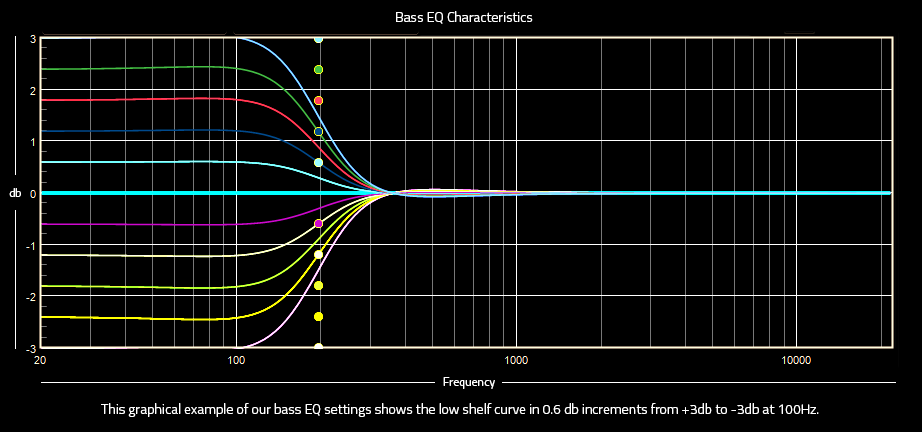
BASS EQ Control Characteristics
It operates as a shelf below 200Hz and provides precision 0.6dB steps over a +/-3dB range. I use this in my personal system in the +3 position to add 1.8dB of boost to my TAD TD-2404 Studio Monitors. These do not have the typical mid-bass bump of many high-end speakers, and they are loaded into a very large volume of space, so this 1.8dB is perfect to get the overall sonic balance just right. I leave this control fixed for all music and occasionally use the TILT for specific recordings, as needed. No compromise here and complete repeatability. It is interesting that a setting of 2 or 4 does not quite cut it, 3 is the Goldilocks setting for my system and room, demonstrating that the 0.6dB setting offers just enough resolution to hit the mark, without driving you crazy with too many discrete steps.
I was recently involved in optimizing system settings for an ACI600 based system using more typical high -end speakers with the mid-bass (circa 100Hz) bump in a much smaller space. There was just too much bass energy, causing mid-band veiling. We set the BASS EQ to -2, trimming 1.2dB off below 200Hz and the system opened right up, without giving any feeling that the low bass energy was lacking.
Living with these filter options to optimize the in-room listening experience, I would be loath to have a system that does not offer this kind of capability. There is no sonic compromise with this control, so it can be used to achieve the goal of optimizing the in-room experience without compromising any aspect of musical playback. These embedded DSP-based IIR controls add no noise or distortion like old-school analog-based EQ or any time domain distortions introduced by FIR room correction filters. Beware, once you experience the system optimizing powers of these controls, there is no going back!